Cart
Is Herringbone Flooring Worth It?
Herringbone brings movement, texture and craftsmanship to an oak floor. Whether it is worth choosing depends on the room, the scale of the pattern and the quality of the installation.
Yes, herringbone flooring can be worth it when you want the floor to make a considered contribution to the interior. The pattern brings movement and character to European oak, but it also asks more of the design and installation. The value is in the complete result: the material, the scale of the block, the direction of the pattern and the skill with which it is laid.
Herringbone is not automatically the right choice for every room. If the interior already has several strong patterns, or the floor is intended to sit almost unnoticed beneath the rest of the scheme, a quieter layout may be more appropriate. A good herringbone floor feels integral to the architecture rather than added as a decorative effect.
At a glance:
- Choose herringbone when: you want the floor to add movement, texture and a visible layer of craftsmanship.
- Plan carefully when: the room is small, irregular or already visually detailed. Block scale and direction become particularly important.
- Consider straight boards when: simplicity, installation speed or a calm, uninterrupted field of oak is the priority.
What are the advantages of herringbone flooring?
The appeal of herringbone is not one feature in isolation. It is the way the geometry works with the grain, colour and natural variation of oak.
- Movement without ornament: The staggered pattern draws the eye across the floor and gives a room a sense of rhythm. In a restrained interior, it can introduce detail without relying on additional colour or decoration.
- A flexible architectural language: Herringbone can sit comfortably in a restored heritage home or a contemporary new build. The effect changes with the oak tone, the block size and the materials around it.
- A strong expression of craft: The pattern makes the set-out and installation visible. When the centre line, borders and transitions are resolved well, the floor reads as part of the architecture.
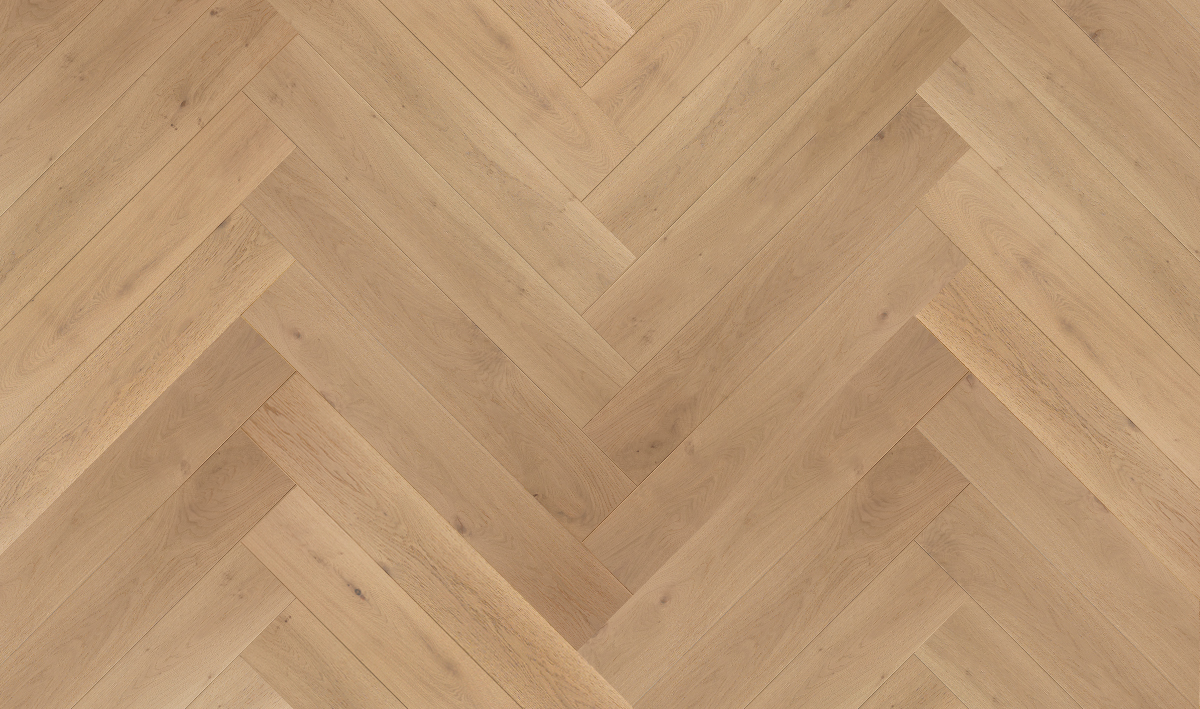
- A wide choice of tone and scale: Royal Oak herringbone is available across a range of European oak colours. Selected products are offered in 90 × 450 mm and wider 148 × 888 mm formats, allowing the proportion of the pattern to respond to the room.
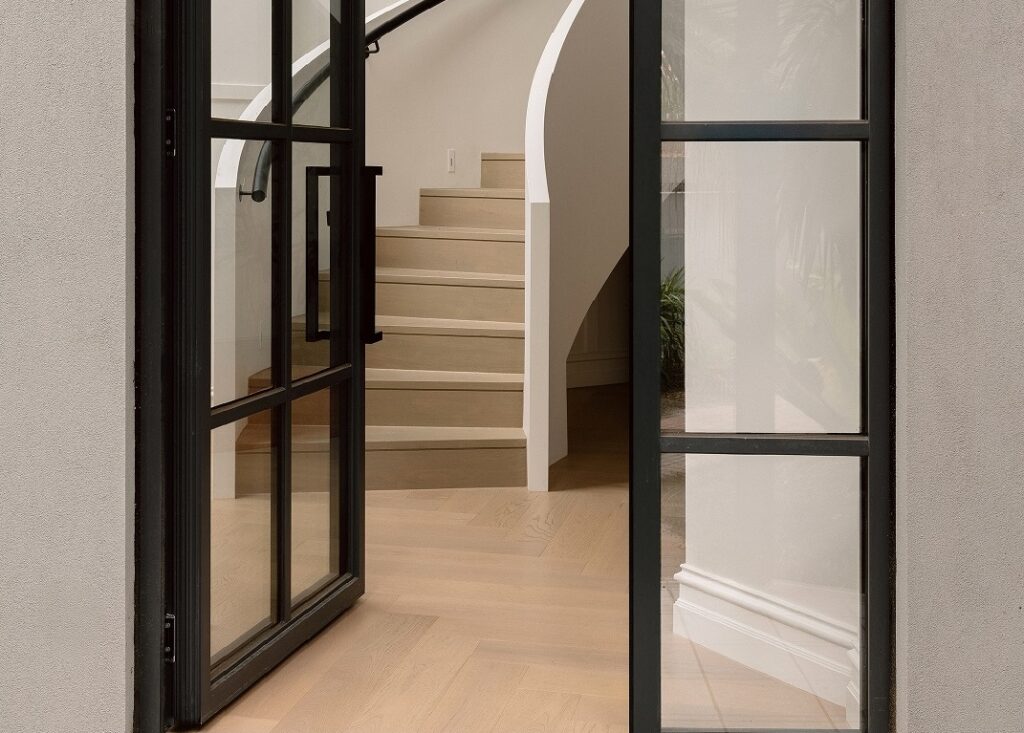
Natural Suede herringbone creates a warm foundation for Avila House, working with warm white walls, dark joinery and matching stained stair treads.
At Avila House, Natural Suede herringbone was selected as a calm foundation for warm white walls and dark feature joinery. Matching stained stair treads carry the same tone through the entry. The pattern is present, but it does not compete with the rest of the room.
At Field House, Saddle Oak herringbone grounds the kitchen, dining and living spaces in a richer mid-brown tone. CJH Studio used it as part of a contemporary interpretation of the home’s original character, alongside expressive marble, stained oak cabinetry and bronze detailing.
These two projects use the same pattern differently. That is the real versatility of herringbone: it does not have one fixed mood.
What are the trade-offs of herringbone flooring?
The clearest trade-offs begin with installation and set-out.
- The set-out needs precision: Herringbone depends on accurate alignment. A small error at the beginning can become more visible as the pattern moves through the room, so we recommend working with an experienced timber-floor installer.
- The material allowance is higher: Our current installation specification recommends allowing up to 20% wastage for a herringbone pattern. The final allowance should be confirmed against the room, the chosen block and the installer’s set-out.
- The pattern needs room to breathe: Herringbone adds visual activity. In a heavily detailed interior, or when the block is out of proportion with the room, the floor can feel busier than intended.
- It is a stronger design commitment: Straight boards tend to recede. Herringbone remains visible. That is an advantage when the pattern supports the design, and a drawback when it has been chosen without reference to the rest of the space.
The pattern itself does not make an oak floor more durable. Performance comes from the engineered construction, the oak wear layer, the finish, the quality of installation and the way the floor is cared for. Royal Oak floorboards use a real European oak surface over an engineered core designed for greater stability in Australian conditions.
For installation preparation and product requirements, refer to our engineered oak flooring installation guidance.
Does herringbone flooring date?
Herringbone has a long architectural history, but that does not mean every herringbone floor will feel timeless. The pattern is only one part of the specification. Colour, finish, block size and the surrounding interior all influence how the floor ages visually.
Natural oak tones and a scale that suits the room tend to give the pattern longevity. A strong tonal contrast, or a block chosen mainly because it is fashionable, can tie the result more closely to a particular moment.
Field House offers a useful example. Its Saddle Oak herringbone does not rely on the pattern alone for impact. The deep brown tone works with the cabinetry, marble and bronze, allowing the floor to support a layered interior. At Avila House, a softer neutral oak creates an entirely different expression. Both feel considered because the floor belongs to the wider material palette.
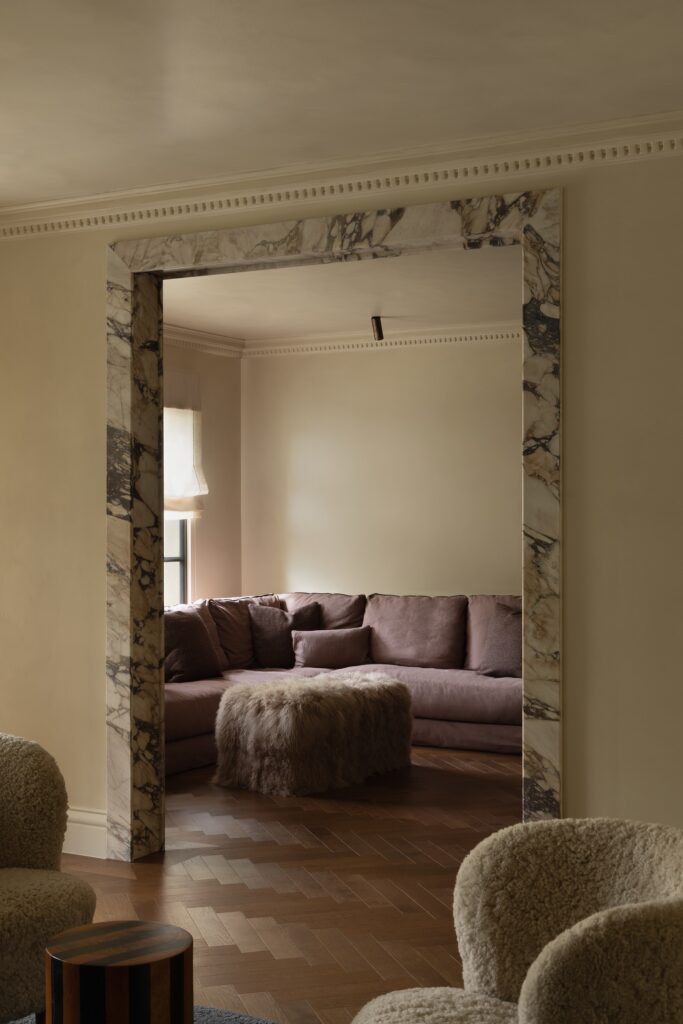
Saddle Oak herringbone grounds Field House in a rich mid-brown tone, balancing heritage character with a contemporary interior.
Does herringbone make a room look bigger?
It can, but it is not a rule. The diagonal movement of the pattern can lead the eye through a room and make its dimensions feel more dynamic. A lighter oak can also reflect more natural light, which may help a space feel open.
The opposite can happen when the scale or direction works against the room. Small blocks across a large open area can create too much visual activity. An oversized block in a compact or irregular room can feel unresolved. Darker tones may create intimacy and depth rather than a sense of openness.
Look at the room as a whole:
- Block scale: The pattern should be legible without overwhelming the floor area.
- Direction: The centre line and the way the pattern meets entries, hallways and adjoining rooms should be planned before installation.
- Colour and light: Pale and mid-tone oak will read differently from a deep smoked finish in the same room.
- Continuity: Extending the same floor through connected spaces can create flow, while a single herringbone area can be used to define a particular zone.
This is why samples and full-room project photography are more useful than viewing one block on its own.
Can herringbone work in a modern home?
Herringbone does not need a traditional interior. Its geometry can bring warmth and texture to simple contemporary spaces, particularly when the oak tone and block size are restrained.
In Spanish Mission House, Toasted Oak appears in both straight boards and herringbone. The combination shows that the pattern does not need to cover every floor to feel connected to the design. It can be used where movement and emphasis are wanted, while straight boards create quieter adjoining areas.
For a modern home, consider:
- a wider herringbone block in a generous open-plan room;
- a pale or natural oak tone where the architecture and joinery are deliberately minimal;
- continuity between the floor, stair details and surrounding timber finishes;
- using the pattern selectively when the interior already contains strong stone, art or joinery.
Toasted Oak is used in straight boards and herringbone at Spanish Mission House, showing how pattern can be introduced selectively.
How do you choose the right herringbone floor?
Begin with the room, not the pattern in isolation.
- Look at the full material palette. Review the oak beside joinery, stone, wall colour and fabrics in the light of the actual space.
- Choose the scale in context. Selected Royal Oak colours are available in both 90 × 450 mm and 148 × 888 mm herringbone formats. The wider format creates a calmer, more expansive rhythm; the narrower block creates a finer and more traditional pattern.
- Plan transitions early. Confirm how the pattern meets hallways, stairs, thresholds and adjoining floor finishes before the set-out is finalised.
- Use an experienced installer. The quality of the set-out is central to the finished result.
- See more than a small sample. Use samples to judge colour and finish, then review full-room installations to understand scale and movement.
If you are still deciding between parquetry patterns, our guide to herringbone and chevron flooring explains how the two geometries differ.
Frequently asked questions
Can Royal Oak herringbone be used with underfloor heating?
Our current installation specification states that in-slab and above-floor heating systems can be used under Royal Oak flooring products when the system and floor are specified and installed correctly. The temperature measured beneath the timber must not exceed 26°C. Review the current specification with the flooring and heating installers before work begins.
Can herringbone and straight boards be used in the same home?
Yes. Spanish Mission House uses Toasted Oak in both layouts, allowing herringbone to add emphasis in selected spaces while straight boards create quieter adjoining areas. Plan the transitions, direction and shared oak tone together so the two layouts feel connected.
How do you care for herringbone engineered oak flooring?
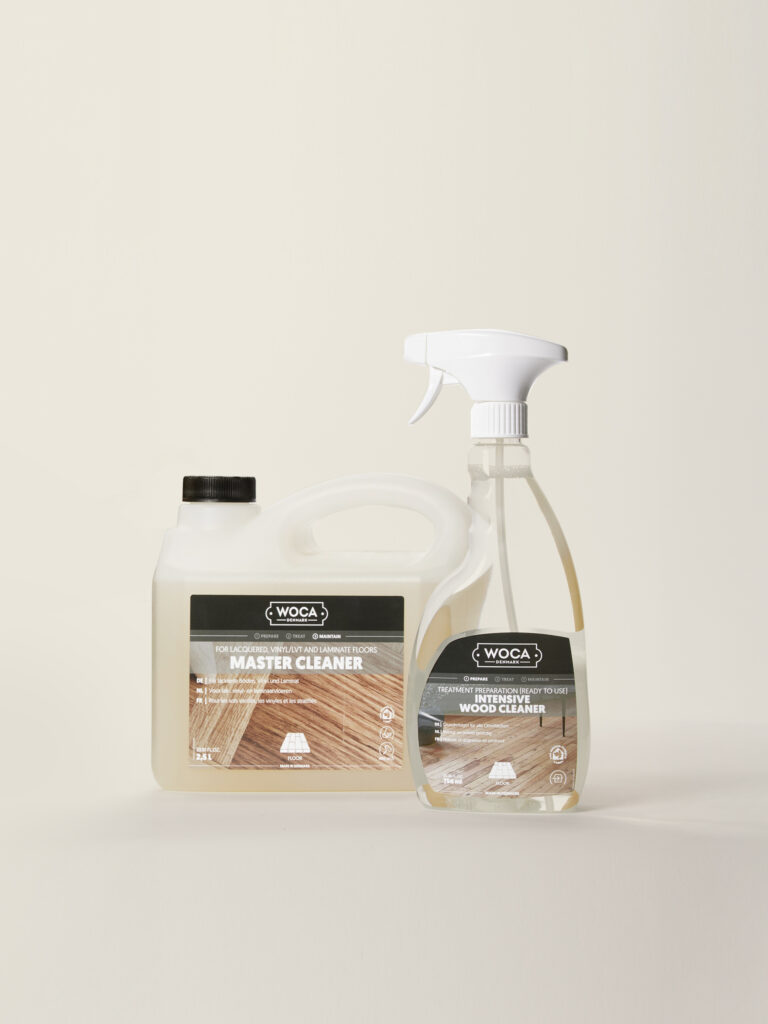
Care for herringbone in the same way as other prefinished engineered oak flooring. Remove grit with a soft broom or suitable vacuum attachment, clean spills promptly and avoid excessive water or harsh household chemicals. Use the cleaning products recommended for the finish.
Explore herringbone across our projects and engineered oak floorboards. Order samples or book a consultation at our Sydney or Melbourne showroom to compare oak tones, block sizes and finishes in person.